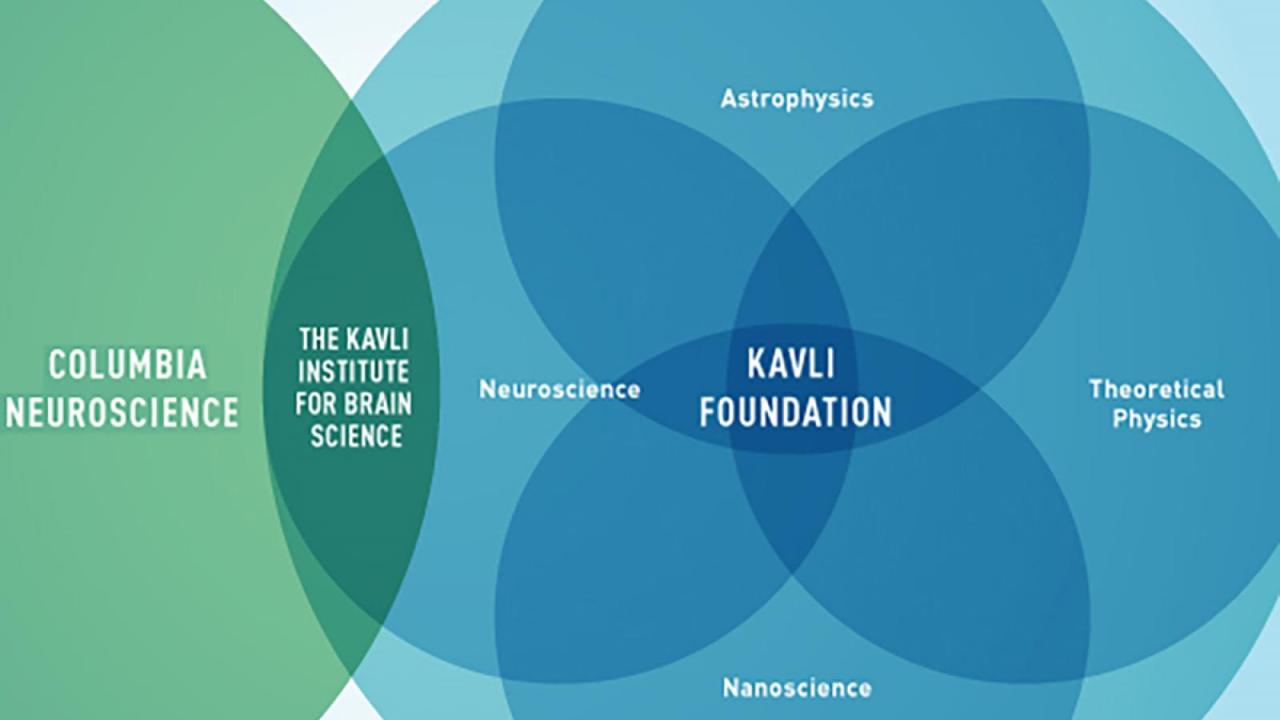
The Kavli Institute for Brain Science at Columbia University was established in late winter 2004 with a gift of $7.5M from the Kavli Foundation. It is the mission of the Institute to develop experimental and computational tools that will allow neuroscientists to move away from the study of individual neurons, to that of complex neural circuits, believed to be the basis for higher mental function and behavior. In addition to these aims, The Institute supports various research and education initiatives here at Columbia University such as annual lectureships and weekly seminars, a university wide undergraduate neuroscience course, a competitive award for graduate work and others.

2010 Kavli Prize Laureates Honored in Oslo


Sept. 7, 2010 (Oslo, Norway) - The 2010 Kavli Prize laureates were presented their awards today by His Majesty King Harzald of Norway during a ceremony at the Oslo Concert Hall. The 90-minute celebration in honor of the laureates also featured addresses by Fred Kavli, founder and chairman of The Kavli Foundation, Nils Christian Stenseth, president of the Norwegian Academy of Science and Letters, and the chairs of the committees charged with selecting the prize recipients.


"Today we celebrate the best of science by honoring these esteemed scientists who, with their groundbreaking work, have taken us a step forward on humanity's journey to better understand and utilize nature," said Fred Kavli... read more


His Majesty King Harald of Norway presents the Kavli Prize in Neuroscience. Left to right: Richard Scheller (Genentech), Thomas Südhof (Stanford University), James Rothman (Yale University), His Majesty King Harald. (Credit: Terje Bendiksby/Scanpix)

2010 Kavli Prize Recipients Announced


June 3, 2010 (Oslo, Norway) - Eight scientists whose discoveries have dramatically expanded human understanding in the fields of astrophysics, nanoscience and neuroscience have been recognized with the award of the million-dollar Kavli Prizes.


The laureates were chosen for research that has transformed our knowledge of basic units of matter, laid the foundations for the field of nanotechnology, revealed the molecular basis for the transfer of brain signals and other physiological functions, and made possible the building of telescopes that can see deeper into space and further back in time... read more


2010 Kavli Prize Laureates in Neuroscience (from left: Richard Scheller, Thomas Südhof, James Rothman)

News at The Institute


At the 2009 Society for Neuroscience Meeting, the Award for Education in Neuroscience was awarded to Tom Jessell, Eric Kandel, and James Schwartz for the textbook Principles of Neural Science


Joy Hirsch presented the 2009 George Gamow Memorial Lecture at the University of Colorado at Boulder


Michael Goldberg elected President of the Society for Neuroscience


Tom Jessell named winner of the 2008 Kavli Prize for Neuroscience


Recent Publications


Kandel Lab:
“Aplysia CPEB can form prion-like multimers in sensory neurons that contribute to long-term facilitation.” Cell, February 2010.


Hen Lab:
“5-HT1A autoreceptor levels determine vulnerability to stress and response to antidepressants.” Neuron, January 2010.


Jessell Lab:
“Stringent specificity in the construction of a GABAergic presynaptic inhibitory circuit.” Cell, October 2009


Yuste Lab:
“Depolarizing effect of neocortical chandelier neurons.” Frontiers of Neural Circuits, October 2009.


Axel Lab:
“Representations of odor in the piriform cortex.” Neuron, September 2009


Salzman Lab:
“The convergence of information about rewarding and aversive stimuli in single neurons.” Journal of Neuroscience, September 2009.


Abbott Lab:
“Generating coherent patterns of activity from chaotic neural networks.” Neuron, August 2009.


Siegelbaum Lab:
“Recruitment of N-Type Ca(2+) channels during LTP enhances low release efficacy of hippocampal CA1 perforant path synapses.” Neuron, August 2009.


Miller Lab:
“Equalization of ocular dominance columns induced by an activity-dependent learning rule and the maturation of inhibition.” Journal of Neuroscience, May 2009.


Goldberg Lab:
“Neurons in the lateral intraparietal area create a priority map by the combination of disparate signals.” Experimental Brain Research, January 2009.